Installation
Overview
This guide is intended to provide detailed instructions on the process of setting up nodes in the new OctaSpace Cube system.
Pre-requisites
Hardware
OctaSpace nodes can range from a Raspberry Pi to CPU-only nodes to multi-GPU machines, each of which can be used for different types of services.
Please check the minimum hardware requirements based on the service you wish to provide.
Operating system
OctaSpace node software runs on Linux distributions and supports both x86 and ARM64 architectures.
You can find the list of supported OS under software requirements.
Before proceeding further, please ensure that you have set up one of the supported operating systems.
HiveOS
In cases where NVIDIA GPUs are used, you must ensure that driver version 550 or newest is installed.
It is crucial that the NVIDIA driver and the libnvidia-gl or libnvidia-gl-server packages have the same minor version.
For example, if the driver version is 550.127.05, the libnvidia-gl-550 package must also have the same version. To check this run the following command:
apt show libnvidia-gl-550In some cases docker may not start correctly due to IPv6 disable. To enable IPv6 edit /etc/default/grub file and remove ipv6.disable=1 in GRUB_CMDLINE_LINUX_DEFAULT option. After run update-grub command and restart machine.
Service Ports and Firewall Configuration
Service ports are primarily used for facilitating the VPN service and providing direct access to services via a web interface that runs on nodes.
In cases where service ports are not configured, all traffic between the node and the end user is, by default, directed through dedicated proxy servers located in the geographical regions closest to the node location.
Configuration of service ports is an optional process ONLY IF NOT providing a VPN service.
Configuring service ports offers benefits such as improved network speeds between the node and the end user, and provides more direct access to the node, resulting in enhanced service quality.
If you do not intend to support VPN or prefer that services be routed through a proxy, you may proceed directly to the installation step.
Configuration
For service ports to function, a node must have a static public IP address.
Depending on your network configuration, if the node is behind a NAT, you will need to configure port forwarding for a range of service ports on the router. Additionally, if the server has a firewall with a DROP policy for all incoming traffic, you will need to allow traffic to the service ports.
By default, the service port range is 51800–51816. Ensure that these ports are forwarded or opened for both TCP and UDP protocols.
Installation and configuration
All commands must be run under root user
GPU drivers
AMD
NVIDIA
apt install -y nvidia-driver-590Storage configuration
You can skip storage configuration if you don't require any special settings. The installation script will automatically allocate 80% of the free disk space on the root filesystem for Docker data.
If you prefer to configure storage manually, you can disable the automatic setup by setting the SKIP_FS_CONFIG variable: export SKIP_FS_CONFIG=1
Every service node need to have disk storage configured. The storage requirements can vary depending on the services that are run on the node, therefore it's important to ensure ample storage is configured.
Storage size depends on services provided by node, please consult hardware requirements.
The disk space will be used for various purposes including, docker images, container data as well as support OctaStorage service. Providing ample storage will ensure improved support of services.
Storage partition should be formatted in XFS filesystem and mounted on /var/lib/docker directory.
Depending on the machine configuration, the number of physical disks, and the presence of a RAID controller, there are multiple ways to configure storage for a service node. Below, we outline several common examples.
Prior to proceeding further, ensure you have installed xfsprogs package:
apt install -y xfsprogsFile based partition through loop device
This method is useful for when a node does not have non allocated disk partitions. We will create file on existing filesystem and mount as partition. In this example we assume that root filesystem (/) has enough free disk space and will use it to store our file based partition.
- Create a 500Gb file that will be used for storage. If you have more spare disk space, set the amount as much as possible.
fallocate -l 500G /docker-data.img- Format it in XFS filesystem
mkfs -t xfs /docker-data.img- Mount and make it mounted on system start
echo "/docker-data.img /var/lib/docker xfs defaults,quota,prjquota,pquota,gquota 0 0" >> /etc/fstab
mkdir /var/lib/docker; mount /var/lib/docker
Install service node software
Install distribution:
curl https://install.octa.space | bashAt the end of the installation, you will be given a unique node token. Use this token to register new node on https://cube.octa.computer
Go to Hosting->Nodes and click Add Node
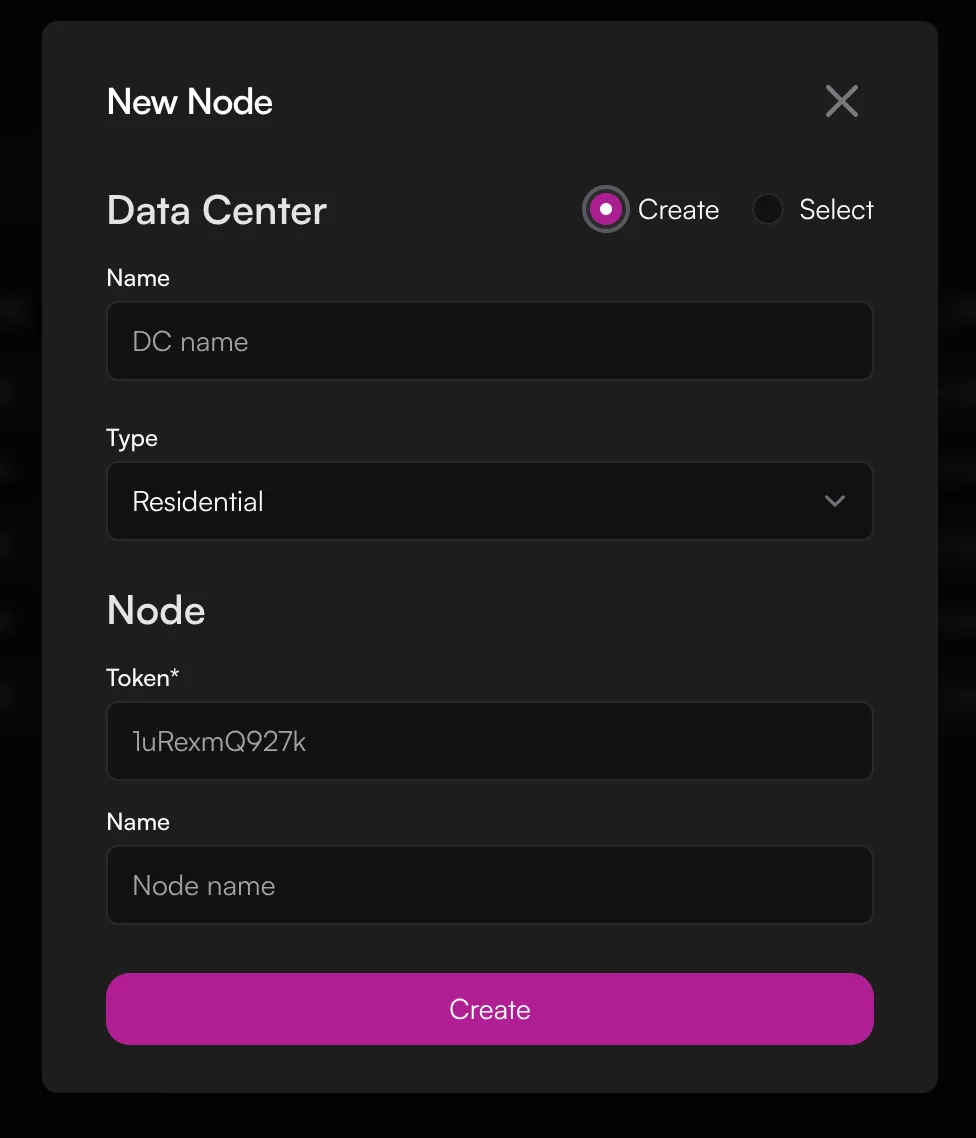
To make node available on marketplace it is necessary to specify Reward Address in profile settings. This address used to receive rewards when node is rented.
Access to Node Dashboard
Dashboard is available on port 18888.
Update service node software
- Stop node service
systemctl stop osn- Update
curl https://install.octa.space | bashUninstall service node software
- Stop and uninstall node service:
systemctl stop osn
systemctl disable osn
rm -f /etc/systemd/system/osn.service- Remove user and data
userdel -r octa